Cycling in a group: Complete guide to mastering safety and performance
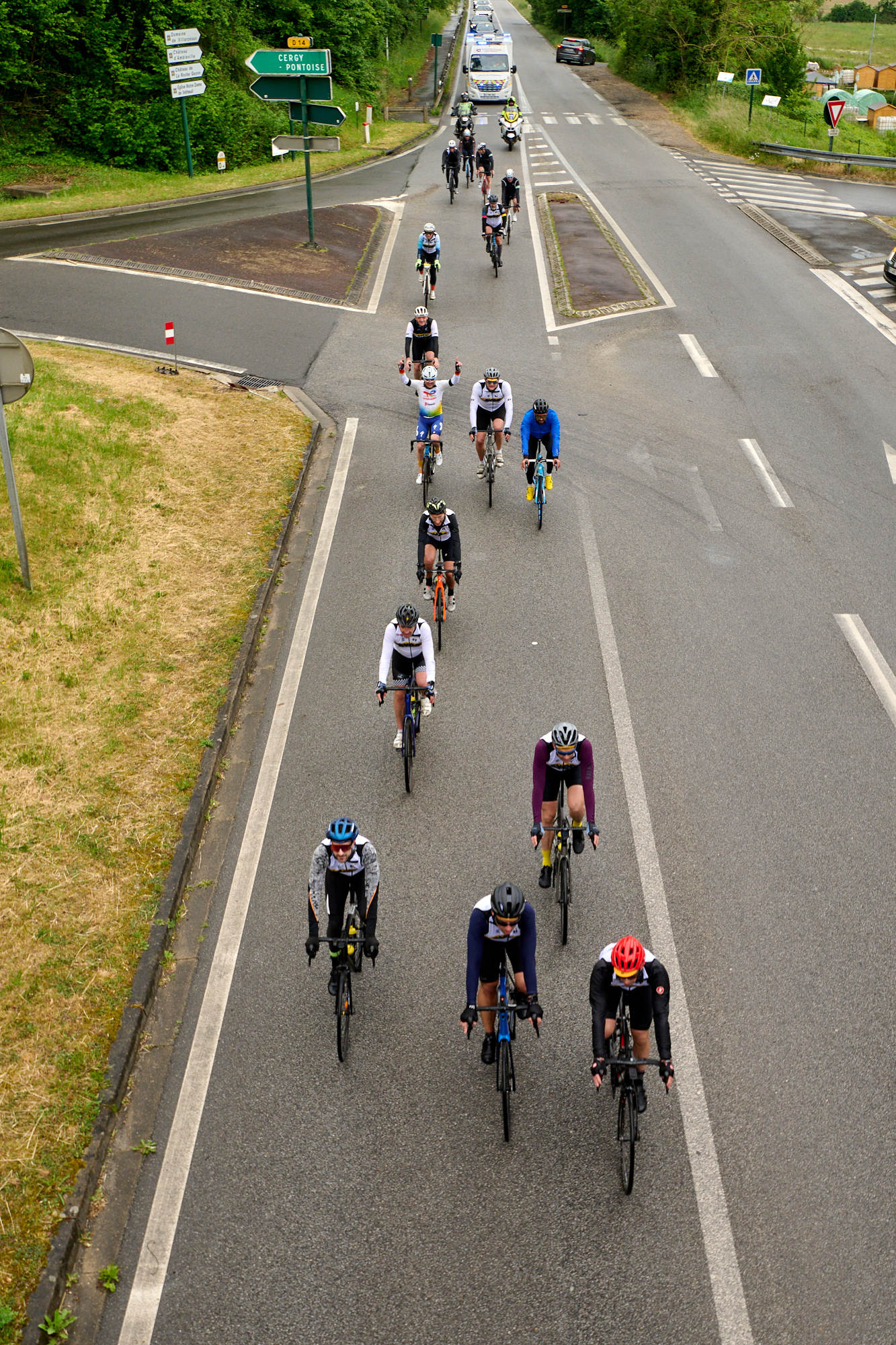
Cycling in a group: complete guide to mastering safety and performance
Master the art of riding in a peloton with proven techniques that combine aerodynamic efficiency, collective safety and shared enjoyment
Riding in a group radically transforms the cycling experience. It multiplies the benefits of cycling: the pace becomes more fluid thanks to aerodynamic slipstreaming, motivation increases with collective energy, and the kilometres fly by almost effortlessly.
Slipstreaming can reduce air resistance by up to 50%, saving considerable energy over long distances. However, this pleasure can quickly turn into tension, or even a dangerous situation, if certain fundamental rules aren't followed.
At Baroudeur Cycling, we've led hundreds of group rides during our cycling holidays in Portugal and France. The proximity of bikes, sustained speed and need to anticipate group movements require technique, communication and mutual respect.
Here is the complete guide to mastering the art of group cycling, combining performance, safety and shared enjoyment.
The scientific advantages of drafting
Understanding aerodynamic efficiency
Aerodynamic drafting is the primary benefit of group cycling. At high speeds, air resistance accounts for up to 95% of a cyclist's total effort.
By riding in another cyclist's slipstream, this resistance drops drastically:
- 20-30% energy saving at 25 km/h (15.5 mph)
- Up to 50% at higher speeds above 35 km/h (22 mph)
This technique is inspired by the formation flight of migratory geese and allows cyclists to maintain paces impossible to achieve solo. A well-organized group can thus ride 5-8 km/h (3-5 mph) faster than an isolated cyclist for the same physiological effort.
Psychological and social benefits
Beyond pure performance, the group generates powerful collective emulation. The presence of other cyclists stimulates motivation, pushes perceived limits, and transforms effort into shared pleasure.
The kilometres fly by more easily, time seems suspended, and the initial objective often becomes secondary to the pleasure of the moment. This social dimension of cycling forges lasting bonds and develops a sense of belonging to a community sharing the same values: effort, respect and self-improvement.
Choosing the right group before hitting the road
Prior level assessment
A poorly suited group compromises the experience entirely: too fast, it will exhaust you within a few kilometres; too slow, it negates the athletic interest and can lead to frustration.
Careful preparation is essential before joining a peloton. Essential information to know:
Route details:
- Total distance and cumulative elevation planned
- Estimated average speed and cruising pace
- Course profile (flat, rolling, mountainous)
- Presence of strategic breaks or refuelling points
Technical requirements:
- Required technical level (descents, narrow roads)
- Group philosophy (performance, leisure, discovery)
Our road cycling holidays and gravel cycling holidays cater to all levels with carefully matched groups.
The different types of group rides
"No-drop" rides: The group stops periodically to allow stragglers to catch up. Pace between regroupings is variable but predictable. Ideal for beginners and progressing with confidence.
"Drop" rides: Sustained pace with no concessions. Cyclists who cannot maintain the pace are dropped permanently. A demanding format reserved for experienced cyclists.
Discovery rides: Emphasis on heritage, local gastronomy, with cultural breaks. Moderate pace favouring sensory pleasure over pure performance.
Our Algarve road cycling holiday perfectly balances performance and discovery.
Baroudeur tip: On your first group rides, position yourself in the middle of the peloton. You benefit from the aerodynamic shelter whilst observing the style, rhythm and habits of your new partners.
For preparation guidance, read our cycling training camp guide.
Communication: the universal language of the peloton
Essential hand signals
Riding together requires communicating together. Hand signals are as important as voice in an effective peloton. Every obstacle, danger or change in pace must be clearly signalled to ensure collective safety.
Universal hand signals:
- Closed fist behind the back: Imminent stop (red light, stop sign)
- Open palm pointed towards the ground: Pothole, obstacle on the ground
- Arm extended laterally: Direction to take, parked vehicle
- Sweeping motion behind the back: Move out to avoid an obstacle
- Hand raised in the air: Mechanical problem, emergency stop
- Dribbling motion with one hand: Gradual slowing down
Effective verbal communication
Vocal announcements complement and reinforce hand signals, especially useful when conditions (wind, traffic) limit visibility.
Standard verbal announcements:
- "Car up!": Vehicle approaching from the front
- "Car back!": Vehicle overtaking the group
- "Hole!": Dangerous pothole
- "Slowing!" or "Speeding up!": Change of pace
- "Clear!": Intersection clear (to be visually verified)
- "Gravel!" or "Dog!": Specific obstacles
Fundamental principle: In a group, every cyclist relays information. The person at the front is not solely responsible for announcements; every participant ensures the safety of those following them.
For comprehensive cycling terminology, consult our cycling jargon guide.
Position and trajectory: the fundamentals of safety
Optimal safety distance
The art of group cycling lies in finding the perfect balance between aerodynamic efficiency and safety. A distance that is too great cancels the benefits of drafting; too close, it exposes riders to domino-effect crashes.
Ideal distance: 30-50 centimetres (12-20 inches) from the preceding wheel depending on conditions. Headwind and flat terrain allow you to get closer; descents and difficult conditions require more reaction space.
Absolute positioning rules
Do not overlap wheels: The front wheel must never be next to the rear wheel of the cyclist in front. This unstable and dangerous position is the main cause of group crashes.
Straight line and predictability: No sudden movements, unexpected changes in pace or deviations from the trajectory. Every move must be announced and gradual.
Accessory management: Drinking, eating or adjusting equipment should be done at the back of the group, never in an exposed position. Concentration must remain maximal.
For technical skill development, read our guide on 5 beginner mistakes to avoid.
Relays: collective efficiency and fluidity
Effective rotation technique
A good rotation maintains the group's consistency. The goal is not to prove your power but to preserve collective harmony. Pace variations prematurely tire the peloton and break the rhythm.
Optimal rotation protocol:
- Progressive takeover: When the preceding cyclist shifts over, slightly increase effort without brutal acceleration
- Maintain the pace: Keep the group's speed, resist the urge to accelerate
- Adapted duration: Relay for 30 seconds to 3 minutes depending on conditions and your ability
- Fluid rotation: Signal the change, shift over progressively, return to the back of the peloton
Energy saving and effort management
Classic rotation: Each cyclist takes their turn at the front and then returns to the back of the group. A simple and accessible method, ideal for beginners.
Continuous rotation ("through-and-off"): Advanced technique where cyclists continuously move through the front. Very efficient but technically demanding, reserved for experienced groups.
Energy saving tip: If you cannot take an effective pull at the front, announce it clearly. Staying at the front consumes 30% more energy. It is better to be honest than to compromise the group's safety.
For proper fuelling during long rides, read our guide on how to fuel properly for long distance cycling.
Pitfalls to absolutely avoid
The "elastic band" effect at the back
At the back of the peloton, changes in pace are considerably amplified. A slight slowdown at the front turns into a sudden brake at the back, creating gaps that are difficult to close.
Preventive solutions:
- Anticipate the group's movements
- Move up in the peloton regularly
- Smooth out pace variations through your pedalling
Adapting to wind conditions
Crosswind: Echelon formation, where each cyclist positions themselves out of the wind relative to the rider in front. A delicate technique requiring coordination and experience.
Headwind: Tightening of the peloton, shorter and more frequent pulls to distribute the effort.
Tailwind: Increased caution as the drafting effect decreases. Enhanced vigilance on safety distances.
Urban crossings and intersections
In urban areas, safety takes absolute precedence over performance. The group tightens up, anticipates traffic lights and intersections, and strictly adheres to the Highway Code.
Specific urban rules:
- Single-file formation is mandatory
- Group stops at red lights
- Respect for priorities and signs
- Maximum vigilance for car doors opening
Team spirit at the heart of the experience
Solidarity and mutual aid
Group riding transcends simple individual performance. It is accepting a collective responsibility where mutual aid and benevolence prevail.
Congratulate a well-managed pull, wait for a teammate in difficulty, and participate in repairs in case of a flat tyre. This philosophy transforms a sports outing into a moment of authentic sharing.
A good peloton functions like a collective machine where every cog contributes to the general harmony.
Managing differences in skill level
In every group, varying skill levels coexist. The stronger riders adapt their effort, and beginners progress through observation and emulation. This diversity enriches everyone's experience when managed well.
Inclusion tips:
- Patience with the less experienced
- Sharing of technical advice
- Adapting the pace to the group's abilities
- Constant encouragement
For comprehensive preparation advice, read our guide on your first cycling trip.
Baroudeur Cycling expertise in group rides
What you won't find anywhere else
At Baroudeur Cycling, our group rides are meticulously designed to combine pleasure, progression and maximum safety.
Homogeneous groups by level: Prior assessment of participants to form balanced groups. Beginner, intermediate and confirmed cyclists ride in pelotons adapted to their experience.
Supervision by expert guides: Our accompanying guides perfectly master group techniques and road safety. Continuous training, perfect knowledge of routes, management of emergency situations.
Systematic safety briefings: Before each departure, a reminder of safety rules, presentation of the route and role distribution. No detail is left to chance.
Selected routes: Our routes prioritise safe roads, smooth traffic and exceptional landscapes. Prior reconnaissance, alternative in case of bad weather, strategic refuelling points.
Our destinations for group cycling
Portugal: Our cycling holidays in Portugal offer exceptional group riding conditions with quiet roads and stunning scenery.
Discover our Algarve gravel cycling tour or our Lisbon to Sagres adventure.
The legendary N2 cycling tour provides the ultimate group riding experience. Read more about cycling the N2 in Portugal.
Explore our Faro to Lisbon gravel tour for varied terrain.
France: Our cycling holidays in France include iconic climbs perfect for group riding.
Conquer Mont Ventoux from Bédoin with a supportive group.
Read about mountain cycling nutrition for climbing performance.
Premium services
Our custom cycling trips can be tailored specifically for your group's abilities and objectives.
If travelling without your bike, our bike rental service in Portugal provides high-quality equipment.
Our cycling coaching programme prepares you specifically for group riding skills.
Statistics from our 2024 group rides
Out of 450 participants in our organized group rides in 2024:
- 96% declared the experience successful and enriching
- 78% significantly improved their group riding technique
- 0 serious accidents thanks to our safety protocol
- 85% registered for new rides within the year
Choosing the right equipment
Essential gear for group riding
For selecting the right bike, consult our guide on which bike to choose for a touring trip.
For first-time buyers, read choosing your first bike.
For smart equipment investments, see our 6 smart investments article.
Exploring premium destination
Algarve cycling paradise
Discover road cycling in the Algarve and our premium Algarve cycling holidays.
Read about our Algarve gravel authentic adventure for off-road group experiences.
FAQ: group riding
Can I ride in a group as a beginner?
Absolutely, provided you choose a group suited to your level and strictly adhere to the basic rules. Start with "no-drop" rides with supportive supervision.
Do I need a special bike for group riding?
A well-adjusted and perfectly maintained road bike is sufficient. Check brakes, drivetrain and tyres before each ride. Safety equipment (helmet, lights) is mandatory.
How do I avoid crashes in a group?
Constant anticipation, respect for safety distances and permanent communication within the group. Never hesitate to widen distances if you feel you are struggling.
What should I do if I can't keep up with the pace?
Immediately communicate your difficulty. In a supportive group, the pace will adapt. If necessary, position yourself at the back and avoid taking pulls.
How do I choose my first group?
Get precise information on the required level, distance and average pace. Prioritise organised groups with supervision to start safely.
Conclusion: the art of riding together
Group riding reveals a new dimension of cycling: faster, farther, with less effort and infinitely more pleasure. This practice demands technique, respect and communication, but in return offers unique sensations and lasting human bonds.
Mastering drafting, anticipating collective movements and communicating effectively transform every ride into a mechanical ballet where performance and harmony combine. Group cycling then becomes a shared art of living, a school of solidarity and mutual self-improvement.
Ready to experience the peloton? Join our cycling holidays and discover the pleasure of group cycling in exceptional settings, led by our passionate experts.
Keywords: cycling in a group, group riding techniques, peloton safety, drafting cycling, cycling communication, group cycling tips, cycling holidays